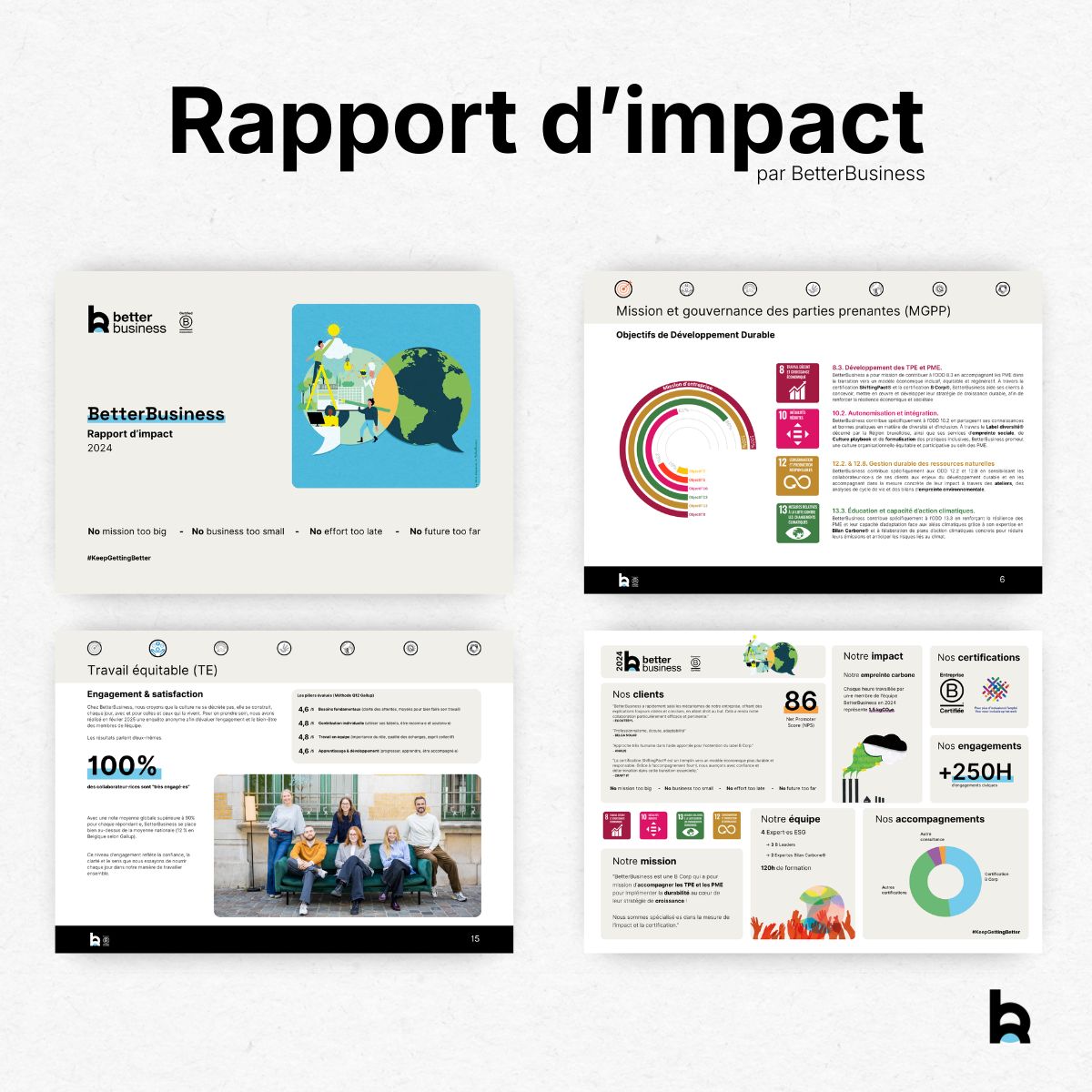

People often say that a company “has impact.” But what does that actually mean?
What effects do your activities have on the environment, your teams, your clients, or society?
And above all: how do you measure it, explain it, and share it sincerely, without exaggeration or oversimplification?
This is precisely the role of the impact report.
This document is not a formality or a communication exercise. It is a clarification tool: it allows you to take stock of your actions, your results, your progress… and sometimes also your limitations.
A tool for transparency and credibility
The impact report responds to a fundamental need: making the reality of your commitments visible.
It highlights the concrete impact of your company on its stakeholders: employees, clients, suppliers, and local community.
Concretely, it enables you to:
- demonstrate transparency to both internal and external audiences,
- structure and tell your sustainability approach in a clear and accessible way,
- strengthen your credibility by avoiding greenwashing thanks to verifiable data,
- highlight what makes you unique and the actions you have truly implemented.
Unlike a rigid institutional report, the impact report adapts to your reality. It is not about ticking boxes, but about sharing your approach with your own words, tone, and priorities.
Showing facts, not promises
At BetterBusiness, we advocate a simple idea: impact is not declared, it is demonstrated.
A useful impact report relies on three pillars:
- Reliable data, drawn from your real activities and placed in context.
- Honest, clear, and concrete storytelling that highlights successes while acknowledging areas for improvement.
- A rigorous method, inspired by solid frameworks such as B Corp, double materiality, or ESRS standards.
Talking about your limitations does not weaken your message, quite the opposite.
It is what makes your approach credible and human. A report that only shows the positive misses the essential: progress.
A tool for learning, progressing, and gaining perspective
An impact report is not only a documentation tool. It is also a tool for reflection.
It helps you take a step back, see the path you’ve taken, and understand what still needs to be done.
Many companies realize, while preparing their report, that they have already progressed more than they thought. They become aware of new initiatives implemented, concrete changes in practices, and the momentum this has created.
The report also allows you to address improvement areas with greater clarity, without judgment. It is a reminder that sustainability is a process of continuous evolution, made of experimentation, adjustments, and progress visible over time.
In this sense, it is not only a measurement tool but also a lever for internal transformation, reinforcing coherence and collective pride.
An accessible method adapted to SMEs
At BetterBusiness, we have designed a pragmatic approach tailored for micro, small, and medium-sized businesses.
Our method is based on five simple steps:
- Prepare: clarify your objectives, target audiences, and the tone to adopt.
- Collect: gather existing data and identify useful additions.
- Analyse: extract key elements and insights to highlight.
- Structure: organize the information to make it clear and readable.
- Write: produce a fluid, aesthetic report that is easy to share.
Each report is co-created with you.
It reflects who you are, supports you, and fits into a sustainable and realistic approach.
A strategic investment, not a formality
A well-designed impact report becomes a genuine management tool and a lever for trust.
It allows you to:
- strengthen your credibility with stakeholders,
- establish constructive dialogue with your teams and partners,
- track your progress over time,
- and differentiate yourself in a market seeking sincere companies.
Often, the data already exists… carbon footprint, ESG diagnosis, ongoing certification, materiality analysis. The impact report brings these elements together, gives them meaning, and makes them visible.
It is a structuring milestone, not an end in itself.
A valuable moment to reflect on the path traveled, acknowledge collective efforts, and look ahead to what comes next.